
The past few years have been marked by several events that have caused global uncertainty and market volatility, from the pandemic and trade tariffs to wars in Europe and the Middle East.
Recent geopolitical tensions and conflicts have added to this uncertainty, and as ever, markets have been quick to react to the unfolding events, which can feel unsettling.
However, periods like this are not new and global events have always influenced markets. But history shows that while markets may react sharply in the moment, these episodes are typically temporary.
Read on to find out what history tells us about the importance of keeping calm amid market volatility.
Significant market fluctuations are more common than not
While a market fall can feel significant in the moment, it often looks less alarming when viewed in a longer-term context.
Indeed, data from Schroders shows that declines of 10% or more occurred in 30 of the 52 calendar years to 2024, and even sharper falls of 20% happened 13 times over the same period.
These figures are based on the MSCI World Index, which has still delivered strong average annual returns over the long term. While past performance isn’t a guide to future results, the historical data shows how regular periods of volatility have been within an overall upward trend.
In the context of recent events, the FTSE 100 fell by around 10% at its lowest point following the onset of the conflict in the Middle East, before beginning to recover.
So, while declines can feel unsettling, they are far from unusual and are a normal part of investing.
Exiting the market amid historical downturns would have been a mistake
When markets start to dip, the instinctive reaction is often to exit and cut your losses. However, while this may seem like the sensible thing to do, it can actually lock in losses that might otherwise have been temporary and mean you miss out on a chance to recover.
Indeed, history shows that amid some of the biggest downturns of the last century, the worst thing to do would have been to exit for cash.
The research from Schroders found that if you exited after the first 25% dip at the start of the Great Depression in 1929, you wouldn’t have broken even until 1963, while those who stayed invested would have recovered by 1945.
Similarly, exiting for cash after the first 25% fall during the 2008 financial crisis would mean you still would not have recovered at the time the study was published in 2024. By contrast, if you stayed invested, you would have recovered by 2013.
So, while exiting may feel like the cautious thing to do, it has typically led to a far longer recovery.
Focusing on the long term and diversifying your portfolio can help manage volatility
During periods of volatility or geopolitical uncertainty, it’s easy to lose sight of the bigger picture. But it’s important to remember two of the key tenets of successful financial planning:
- Focus on long-term growth rather than short-term movements
- Maintain a diversified portfolio to help weather fluctuations.
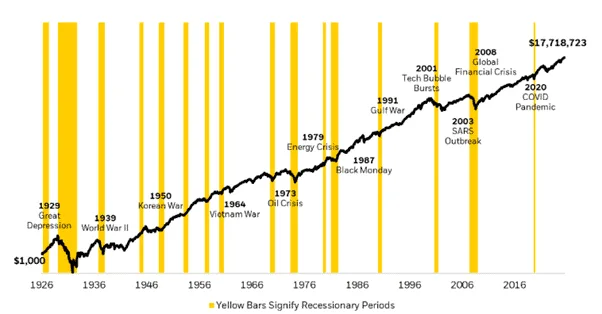
On long-term market growth, the chart below shows how $1,000 invested in the US stock market in 1926 would have grown by 2024, alongside recessions over the same period.
Source: iShares
As you can see, despite multiple crises and dips, $1,000 would have grown to more than $17 million, and the market has continued to grow over the long term.
That said, investing is always a balance between risk and reward. But one of the most effective ways to reduce risk and the impact of volatility on your wealth is to diversify your portfolio.
Concentrating your investments in any area can leave you exposed to downturns if that area underperforms. However, by spreading your investments across different sectors, regions, and asset classes, you reduce reliance on any single area.
This can help smooth returns over time, as losses in one part of your portfolio may be offset by gains elsewhere.
A financial planner can help you through market fluctuations
Market volatility can feel daunting, but a financial planner can provide guidance and reassurance during periods of uncertainty.
They can help you remain resilient and disciplined through ups and downs by ensuring you focus on time in the market rather than trying to time it perfectly. They can also work with you to diversify your holdings to help ensure your journey towards long-term growth remains steady and stable.
To speak to a financial planner, get in touch.
Email info@blueskyifas.co.uk or call us on 01189 876655.
Please note
This article is for general information only and does not constitute advice. The information is aimed at individuals only.
All information is correct at the time of writing and is subject to change in the future.
The value of your investments (and any income from them) can go down as well as up and you may not get back the full amount you invested. Past performance is not a reliable indicator of future performance.



 Production