
The 2020s have been tumultuous so far.
From the pandemic and AI developments to trade disputes and wars, the first six years of the decade have not been short of worrying headlines.
The markets have not been oblivious to the persistent noise, and there have been periods of considerable volatility along the way. But despite frequent fluctuations and wider uncertainty, markets have delivered strong returns over the decade so far.
However, it can be challenging to tune out the noise, especially in the age of 24-hour news and social media, where everyone has an opinion on what may or may not happen next.
Read on to find out why it’s important to drown out the noise on your journey to long-term growth.
Despite multiple events that have led to volatility, markets have been strong in the 2020s so far
Since the start of the 2020s, there have been multiple events that have caused significant market reactions.
The Covid pandemic saw markets fall by 34% in 32 days. The launch of the Chinese AI model DeepSeek in 2025 triggered a mass sell-off, with Nvidia losing over $500 billion in a single day. Trump’s “Liberation Day” tariffs saw significant downturns across the world, and the Russian invasion of Ukraine led to the highest inflation in 40 years. More recently, the US and Israeli military action in Iran has also caused markets to dip.
While many of these events were undoubtedly seismic, the markets have remained resilient over the long term.
For instance, the S&P 500 ended 2019 at around 3,231, and by April 2026, it was at 7,209, marking a rise of roughly 123% across a period that included every one of those crises.
So, markets didn’t only recover; they also reached record highs.
Of course, volatility is real, and it’s important to be prepared for it. But the 2020s so far serve as a reminder of the importance of ignoring short-term noise and focusing on long-term trends instead.
The graph below shows the S&P 500’s performance since 2020 alongside some of the key events of the decade.
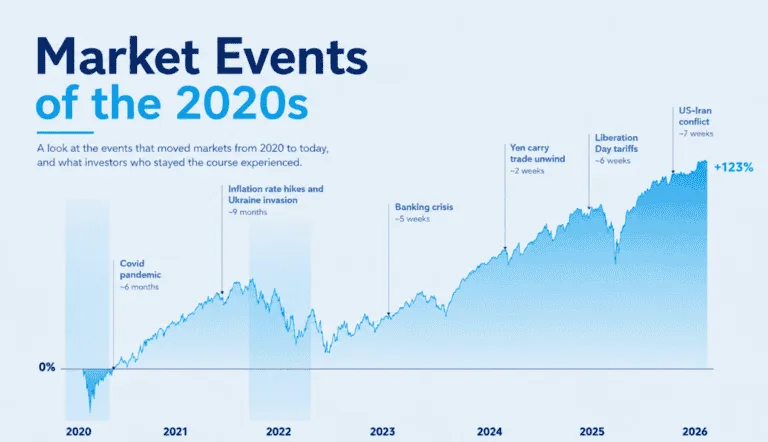
As you can see, some of the market downturns have been significant, but the long-term trend remains towards growth.
So, while it can be easy to get distracted or scared by the latest noise, markets have shown themselves to be resilient in the face of multiple crises.
Listening to noise can mean you’ll miss out on market rebounds
It’s also important to note that some of the strongest periods of market growth tend to follow the sharpest falls.
Research from Schroders found that this was the case after several major market crises. For example, in the year following a single-day drop of 8.9% during the 2008 financial crisis, the S&P 500 went on to gain nearly 40%. This means that those who sold during the downturn would have missed the chance to recover.
This is why discipline typically matters more than timing. Successful long-term investing is often about your ability to stay invested even when things feel uncertain.
However, maintaining resilience can be easier said than done, so it’s important to keep key financial planning principles in mind. These include:
- Keeping a long-term focus – Markets have always reacted to global events, and they always will. However, short-term fluctuations have historically not influenced the long-term trajectory towards growth. So, it’s a good idea to stay focused on the latter, rather than letting your decisions be swayed by the former.
- Diversification – Portfolio diversification involves spreading your investments across regions, sectors, and asset classes so that you’re not overly reliant on one market and no single event can derail everything at once. We can help you diversify your portfolio based on your risk profile and time horizon.
By incorporating these two simple but powerful principles, you can build a plan that’s designed to weather market fluctuations and built to capture long-term growth.
To speak to a financial planner, get in touch.
Email info@blueskyifas.co.uk or call us on 01189 876655.
Please note
This article is for general information only and does not constitute advice. The information is aimed at individuals only.
All information is correct at the time of writing and is subject to change in the future.
Please do not act based on anything you might read in this article. All contents are based on our understanding of HMRC legislation, which is subject to change.
A pension is a long-term investment not normally accessible until 55 (57 from April 2028). The fund value may fluctuate and can go down, which would have an impact on the level of pension benefits available.
The value of your investments (and any income from them) can go down as well as up and you may not get back the full amount you invested. Past performance is not a reliable indicator of future performance.



 Production